Chemistry — Semester B
Free Practice · 10 Questions · 20 min
20:00Exit
1
2
3
4
5
6
7
8
9
10
Question 1 of 10
TEKS 8A-8DEasy Calc Word

How many moles of water are present in 36.0 g of H₂O? (Molar mass of H₂O = 18.0 g/mol)

A0.500 mol
B2.00 mol
C18.0 mol
D1.00 mol
Explanation
📌 Moles = mass ÷ molar mass = 36.0 g ÷ 18.0 g/mol = 2.00 mol. Repeat after me: grams → moles is ALWAYS division by molar mass. Multiplying produces an unreasonably huge answer (the 18.0 mol option shows that error).
Question 2 of 10
TEKS 13A-13DMedium Calc Word Image

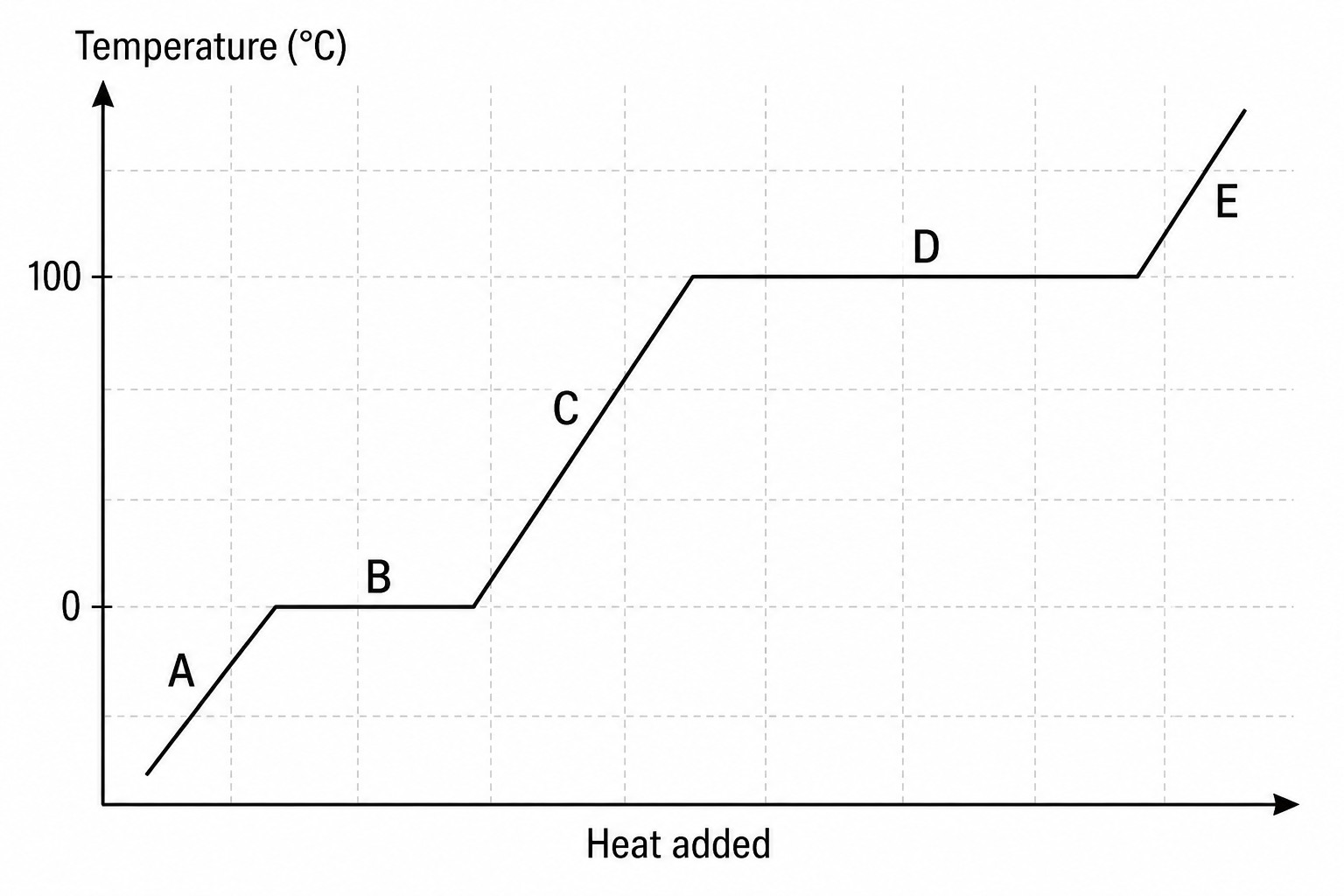
The heating curve below shows the temperature of water as heat is added at a constant rate. During which labeled segment is the water BOILING (changing from liquid to gas)?
Question image
ASegment B
BSegment E
CSegment A
DSegment D
Explanation
📌 Heating curves show flat plateaus at phase change temperatures (heat goes into breaking intermolecular forces, NOT raising temperature). For water: plateau at 0 °C = melting; plateau at 100 °C = boiling. Segment D is the 100 °C plateau → boiling (liquid → gas). Segment B is the 0 °C plateau → melting. Segments A, C, E are sloped → temperature rising within a single phase. The boiling plateau is typically LONGER than melting because vaporization requires more energy.
Question 3 of 10
TEKS 9A-9DMedium Word

Aluminum reacts with oxygen gas to produce aluminum oxide: Al + O₂ → Al₂O₃. When this equation is balanced using the smallest whole-number coefficients, what is the coefficient of O₂?

A1
B2
C3
D4
Explanation
📌 Balanced: 4 Al + 3 O₂ → 2 Al₂O₃. Start by balancing aluminum: 2 Al₂O₃ contains 4 Al, so you need 4 Al on the left. Then balance oxygen: 2 Al₂O₃ contains 6 O atoms; since O₂ provides 2 O per molecule, you need 3 O₂. Always balance metals/nonmetals first and leave free elements (like O₂) for last.
Question 4 of 10
TEKS 11A-12EMedium Calc Word

What is the molarity of a solution that contains 0.500 mol of NaCl dissolved in enough water to make 250 mL of solution?

A0.125 M
B2.00 M
C125 M
D0.500 M
Explanation
📌 Molarity (M) = moles of solute ÷ liters of solution = 0.500 mol ÷ 0.250 L = 2.00 M. Common error: forgetting to convert mL to L. 250 mL = 0.250 L. Molarity tells you concentration; don't confuse with molality (moles per kg solvent).
Question 5 of 10
TEKS 8A-8DEasy Calc Word

What is the mass, in grams, of 1.00 mol of oxygen gas (O₂)? (Atomic mass of O = 16.0 amu)

A8.00 g
B64.0 g
C32.0 g
D16.0 g
Explanation
📌 O₂ contains TWO oxygen atoms, so molar mass = 2 × 16.0 = 32.0 g/mol. For 1.00 mol of O₂: mass = 1.00 × 32.0 = 32.0 g. Common error: using the atomic mass of single O (16.0) instead of the diatomic O₂ (32.0). Always check whether the species is monatomic or diatomic.
Question 6 of 10
TEKS 9A-9DMedium

When the equation Fe + Cl₂ → FeCl₃ is balanced with the smallest whole-number coefficients, the coefficient of Cl₂ is:

A1
B2
C6
D3
Explanation
📌 Balanced: 2 Fe + 3 Cl₂ → 2 FeCl₃. Cross-check Cl atoms: 3 Cl₂ provides 6 Cl atoms on the left; 2 FeCl₃ contains 6 Cl atoms on the right. Cross-check Fe: 2 on each side. Tip: when one side has a diatomic element and the other has an odd Cl count in the compound, you typically need fractional or even coefficients — multiply through to clear.
Question 7 of 10
TEKS 11A-12EEasy Word Image

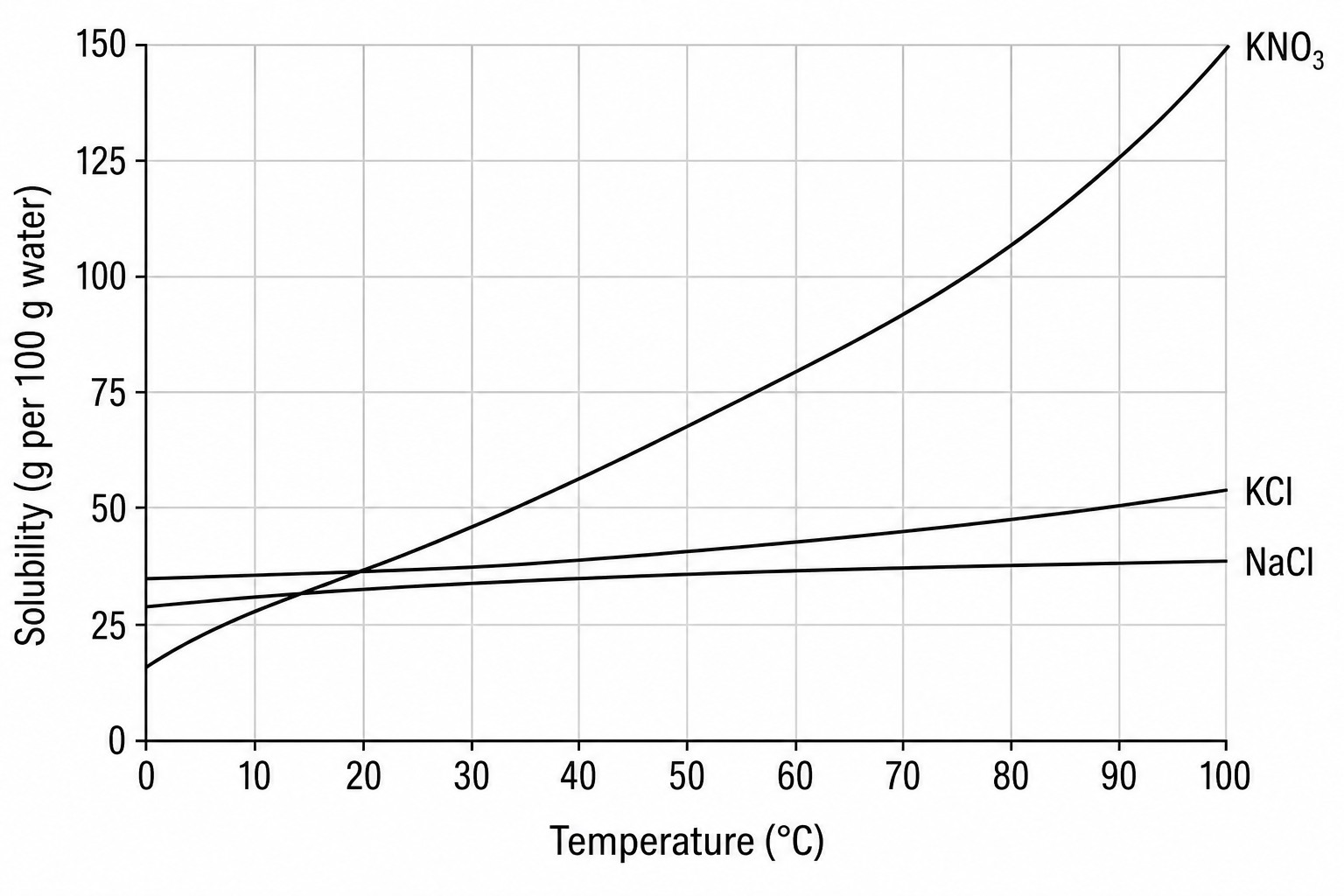
Use the solubility curve below to determine which substance has the GREATEST solubility in 100 g of water at 50 °C.
Question image
AKCl (potassium chloride)
BKNO₃ (potassium nitrate)
CNaCl (sodium chloride)
DThey all have equal solubility at 50 °C
Explanation
📌 Reading vertically at the 50 °C line, the substance whose curve is HIGHEST on the y-axis has the greatest solubility. KNO₃ reaches ~85 g/100 g water at 50 °C, while NaCl is ~38 g and KCl is ~42 g. KNO₃ also shows the steepest temperature dependence (typical of most ionic salts), while NaCl's solubility barely changes with temperature.
Question 8 of 10
TEKS 13A-13DEasy Word

During the combustion of methane (CH₄), the surroundings become hotter and energy is released as heat. This reaction is best classified as:

AExothermic with positive ΔH
BEndothermic with negative ΔH
CExothermic with negative ΔH
DEndothermic with positive ΔH
Explanation
📌 Exothermic = heat exits the system → surroundings warm up. By convention, when the system LOSES energy, the change in enthalpy (ΔH) is NEGATIVE. Endothermic reactions absorb heat (ΔH positive, surroundings cool). All combustion reactions are exothermic — that's why they're used as fuels.
Question 9 of 10
TEKS 10A-10CEasy Word

Which statement about an ideal gas is TRUE according to the kinetic molecular theory?

AIdeal gas particles attract each other strongly
BIdeal gas particles have significant volume
CIdeal gas particles slow down as temperature rises
DIdeal gas particles move randomly and collide elastically
Explanation
📌 Kinetic Molecular Theory assumes ideal gas particles (1) have negligible volume relative to the container, (2) experience no intermolecular forces, (3) move in random straight-line motion, (4) undergo elastic collisions (no energy lost), and (5) have average kinetic energy proportional to absolute temperature. Real gases deviate at high pressure and low temperature.
Question 10 of 10
TEKS 14A-14CMedium Calc Word Image

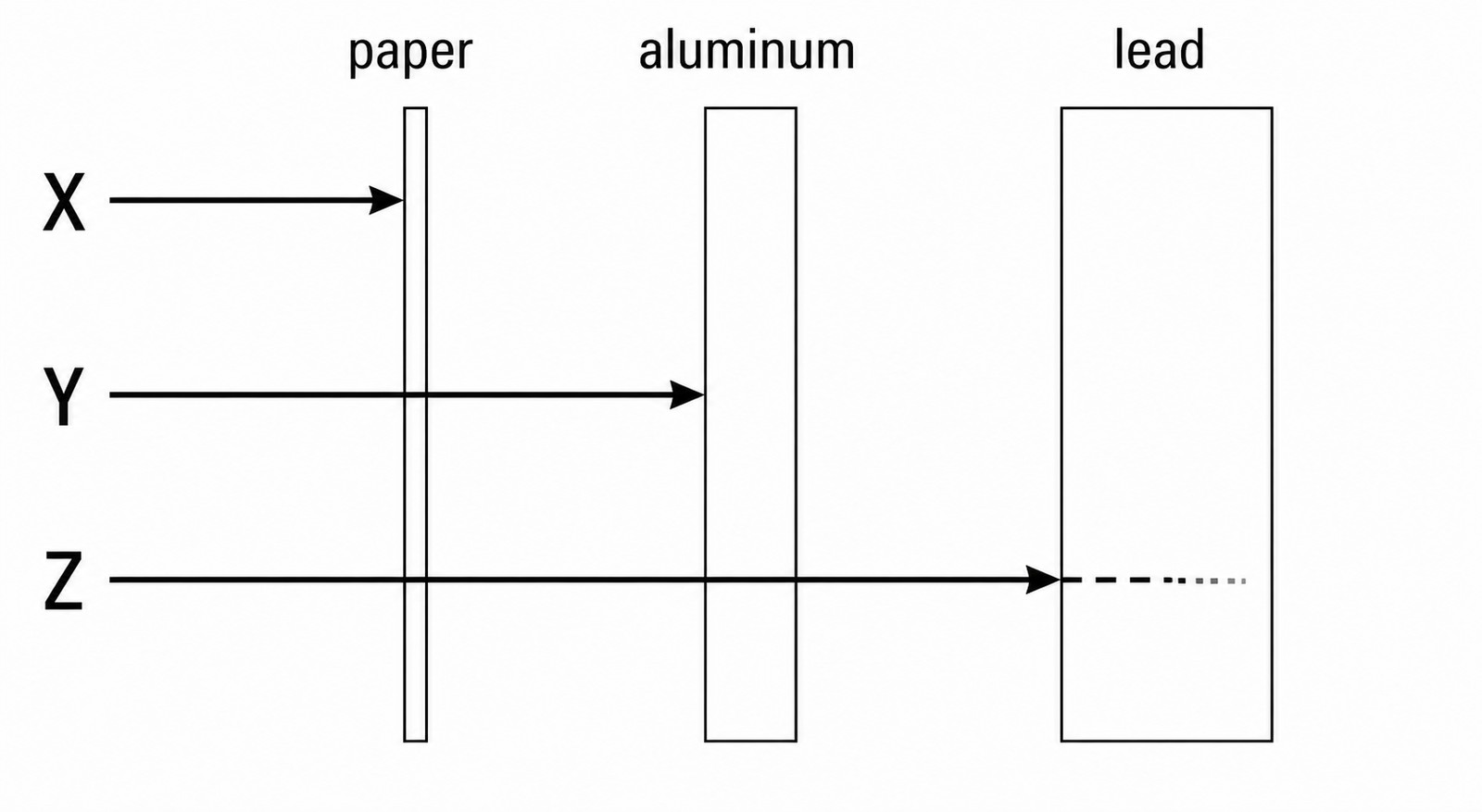
The diagram below shows three types of radioactive emission passing through three barriers. Based on penetrating power, which curve represents BETA particles?
Question image
ANone of the curves represent beta particles
BZ
CY
DX
Explanation
📌 Penetrating power: alpha (lowest) < beta < gamma (highest). Alpha is stopped by paper or skin (X). Beta penetrates paper but is stopped by aluminum foil (Y). Gamma rays pass through paper and aluminum, requiring thick lead to attenuate (Z). The size and charge of the particle determine this: alphas are large/heavy (helium nuclei), betas are small fast electrons, gammas are massless photons.

Score
Correct
Wrong
Try Again Exit