Industrial Revolution & Immigration: Cotton Gin to Ellis Island
Between 1790 and 1920, America transformed from an agricultural nation to an industrial powerhouse. Master the key inventions, the rise of immigration, and the cities they built.


An industrial transformation
In 1800, 80% of Americans worked in agriculture. By 1920, less than 30% did. Three forces drove that shift: inventors, immigrants, and infrastructure.
Inventions that changed everything
Five inventions you must know
- Cotton Gin (Eli Whitney, 1793) — separated cotton fibers from seeds 50× faster. Made cotton king of Southern agriculture; tragically also entrenched slavery.
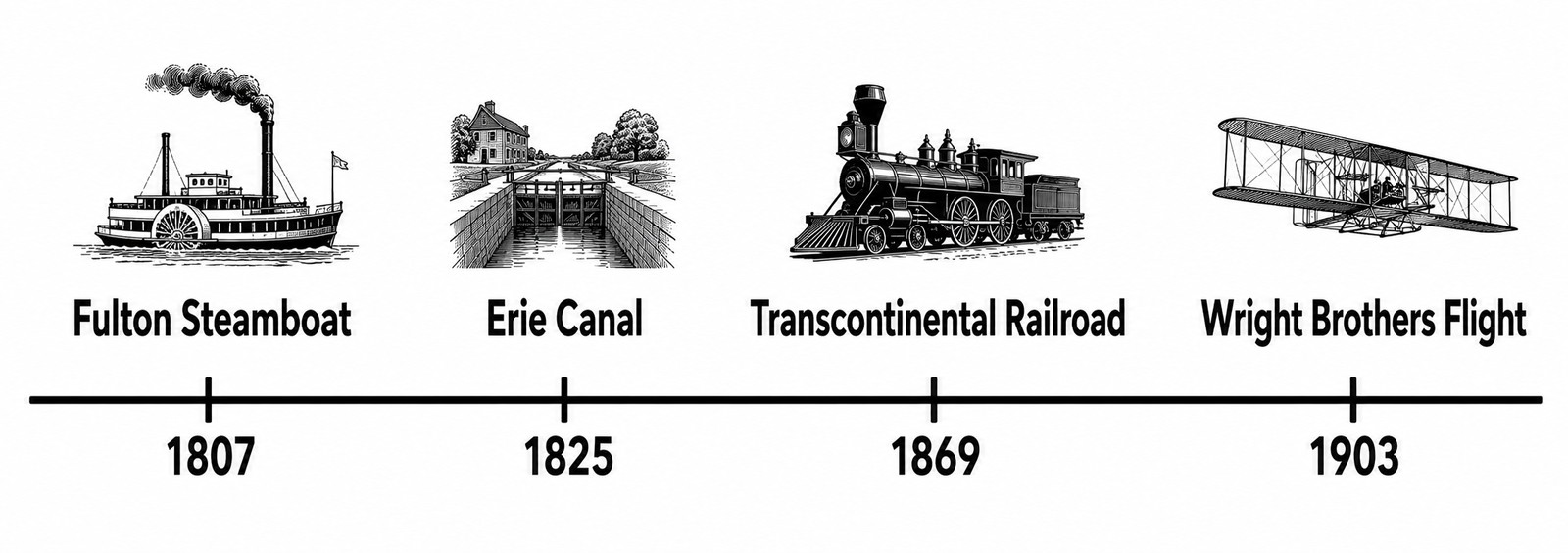
- Steamboat (Robert Fulton, 1807) — turned upstream rivers into highways.
- Telegraph (Samuel Morse, 1840s) — first instant long-distance communication. Sent "What hath God wrought" in 1844.
- Transcontinental Railroad (completed 1869, Promontory Summit, Utah) — connected the East and West coasts. Reduced cross-country travel from 6 months to 6 days.
- Assembly Line (Henry Ford, 1913) — made the Model T affordable to middle-class workers. Production time per car: 12 hours → 90 minutes.
The great immigration waves
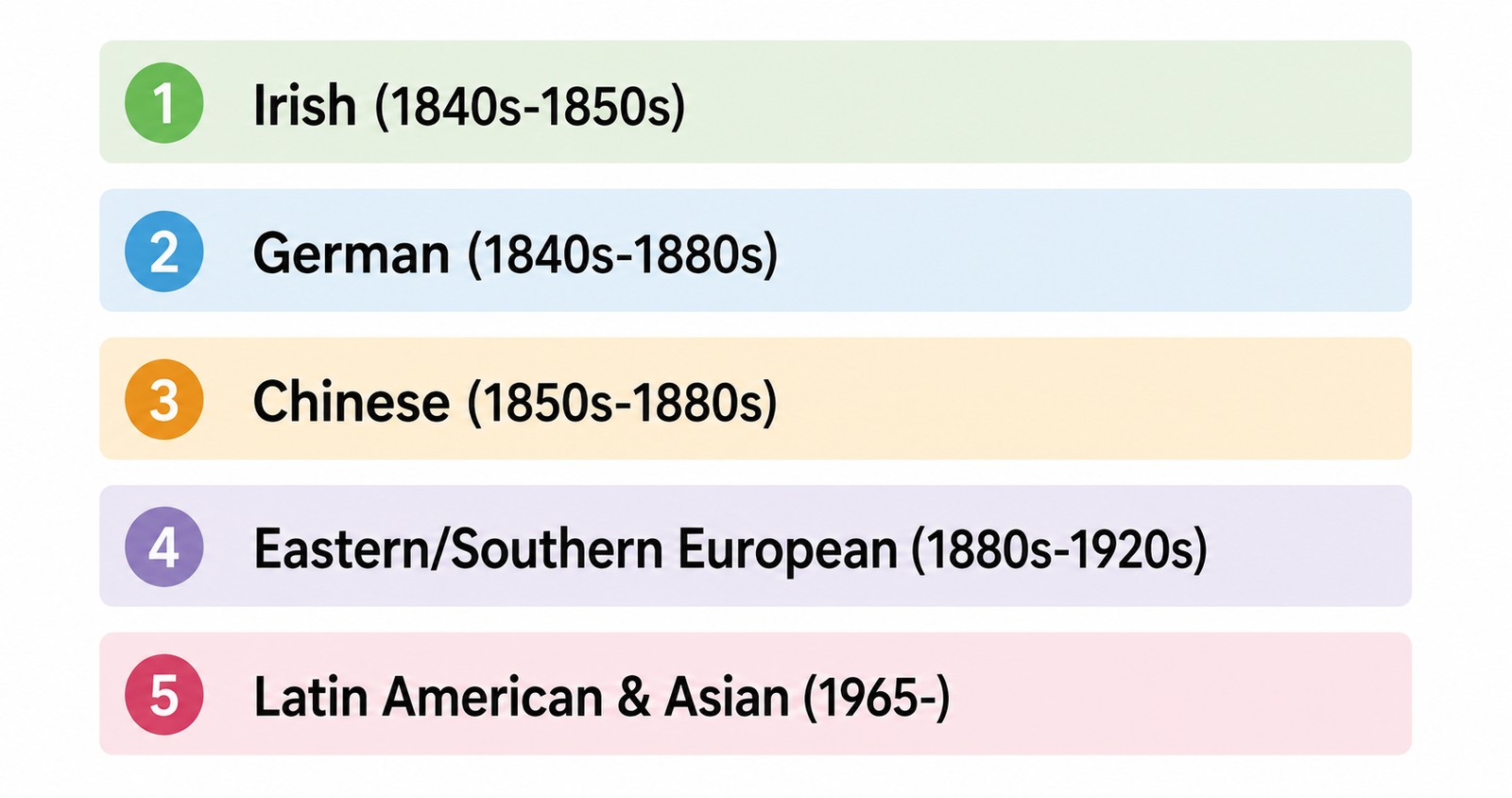
- Irish (1840s-1850s) — the Irish Potato Famine killed a million people in Ireland; another million fled, mostly to American cities like Boston and New York.
- German (1840s-1880s) — political unrest after 1848 European revolutions and economic opportunity. Settled mostly in the Midwest.
- Chinese (1850s-1880s) — initially drawn by California Gold Rush, later worked on the Transcontinental Railroad. Faced harsh discrimination culminating in the Chinese Exclusion Act of 1882.
- Eastern and Southern European (1880s-1920s) — Italians, Poles, Russians, Jews fleeing pogroms. Entered through Ellis Island. By 1920, 14% of Americans were foreign-born.
- Latin American and Asian (1965-) — after the 1965 Immigration Act ended national-origin quotas, immigration shifted from Europe to Asia and Latin America.
Check yourself
Quick check #1
Who invented the cotton gin in 1793?
Eli Whitney's cotton gin (1793) made cotton processing 50× faster. It transformed the Southern economy — and tragically expanded slavery, since more cotton meant more demand for enslaved labor.
Quick check #2
What primarily drove Irish immigration to the United States in the 1840s?
The Great Famine (1845-1852) killed about a million people in Ireland and forced another million to emigrate. Most settled in American port cities — Boston, New York, Philadelphia.