WWII to the Cold War: Pearl Harbor to the Berlin Wall
From Pearl Harbor (1941) to the fall of the Berlin Wall (1989), the US fought a hot war and a cold one. Master the major events of both.


Two wars, one century
WWII ran four years (1941-1945) and killed about 60 million people worldwide. The Cold War that followed lasted 44 years (1947-1991) and shaped almost every aspect of American foreign policy in the second half of the 20th century.
World War II (1941-1945)
WWII essentials
- Pearl Harbor (Dec 7, 1941) — Japanese aerial attack on US naval base in Hawaii. FDR called it "a date which will live in infamy." US entered the war the next day.
- D-Day (June 6, 1944) — Allied invasion of Normandy, France. The largest amphibious assault in history (~156,000 troops). Began the liberation of Western Europe.
- Atomic bombs (Aug 1945) — Hiroshima (Aug 6) and Nagasaki (Aug 9). Japan surrendered Aug 15.
- Holocaust — Nazi Germany murdered ~6 million Jews and ~5 million others (Roma, disabled, Soviet POWs, political prisoners). Discovered when Allied troops liberated concentration camps in 1945.
- United Nations (founded 1945) — created to maintain international peace and prevent another world war. Replaced the failed League of Nations.
The Cold War (1947-1991)
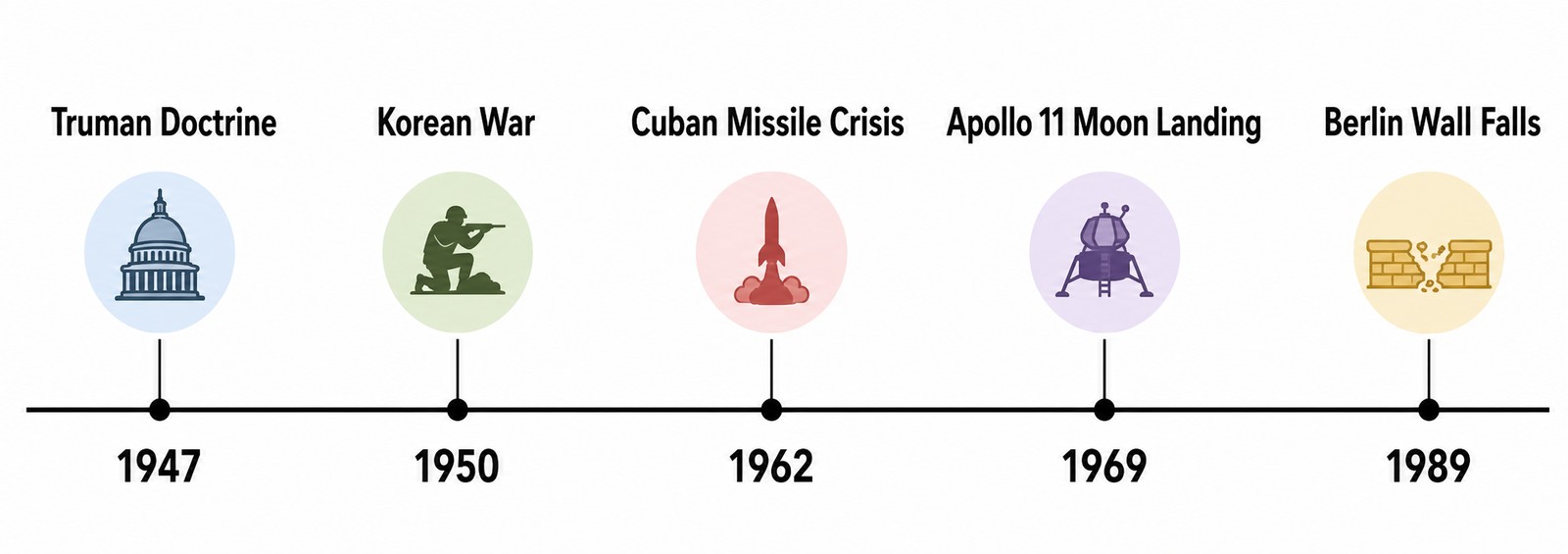
After WWII, the US and Soviet Union — recent allies — became geopolitical rivals. Both had nuclear weapons. Direct war was unthinkable, so the conflict played out in proxy wars, espionage, propaganda, and a space race.
- Truman Doctrine (1947) — pledged US support to countries resisting Soviet communism. Launched 40 years of containment policy.
- Marshall Plan (1948) — $13 billion in aid to rebuild Western Europe.
- Korean War (1950-1953) — first hot conflict. Ended in stalemate at the 38th parallel.
- Sputnik (1957) — Soviet satellite launch. Shocked the US into massive science education investment and eventually NASA.
- Cuban Missile Crisis (1962) — 13 days that brought the US and USSR to the brink of nuclear war over Soviet missiles in Cuba.
- Vietnam War (1965-1973) — most divisive war in American history. Ended in US withdrawal.
- Apollo 11 (1969) — US won the Space Race by landing humans on the Moon.
- Fall of Berlin Wall (1989) — symbolic end of the Cold War. Soviet Union dissolved 1991.
Check yourself
Quick check #1
Which Cold War event brought the US and USSR closest to nuclear war?
In October 1962, US spy planes spotted Soviet nuclear missiles in Cuba. Kennedy imposed a naval blockade; for 13 days the world was on the edge. Khrushchev backed down — the closest call in human history.
Quick check #2
What was the primary purpose of creating the United Nations in 1945?
After WWII killed 60 million people, world leaders created the UN to prevent a third world war. It replaced the toothless League of Nations and gave the US (which had refused League membership) a permanent seat on the Security Council.