Cell Membrane & Transport: How Things Get In and Out
The cell membrane is the boundary that decides what enters and leaves. Master the phospholipid bilayer, transport proteins, osmosis, diffusion, and active transport in one focused lesson.
8 minTEKS 5A-11BBiology
The membrane is a smart fence, not a wall
The cell membrane decides what enters and what leaves the cell. It looks simple but does five jobs at once: it’s a barrier, a checkpoint, a signal receiver, an identity tag, and a transport hub. Two structural features make all of this possible — and both are tested directly on the CBE.
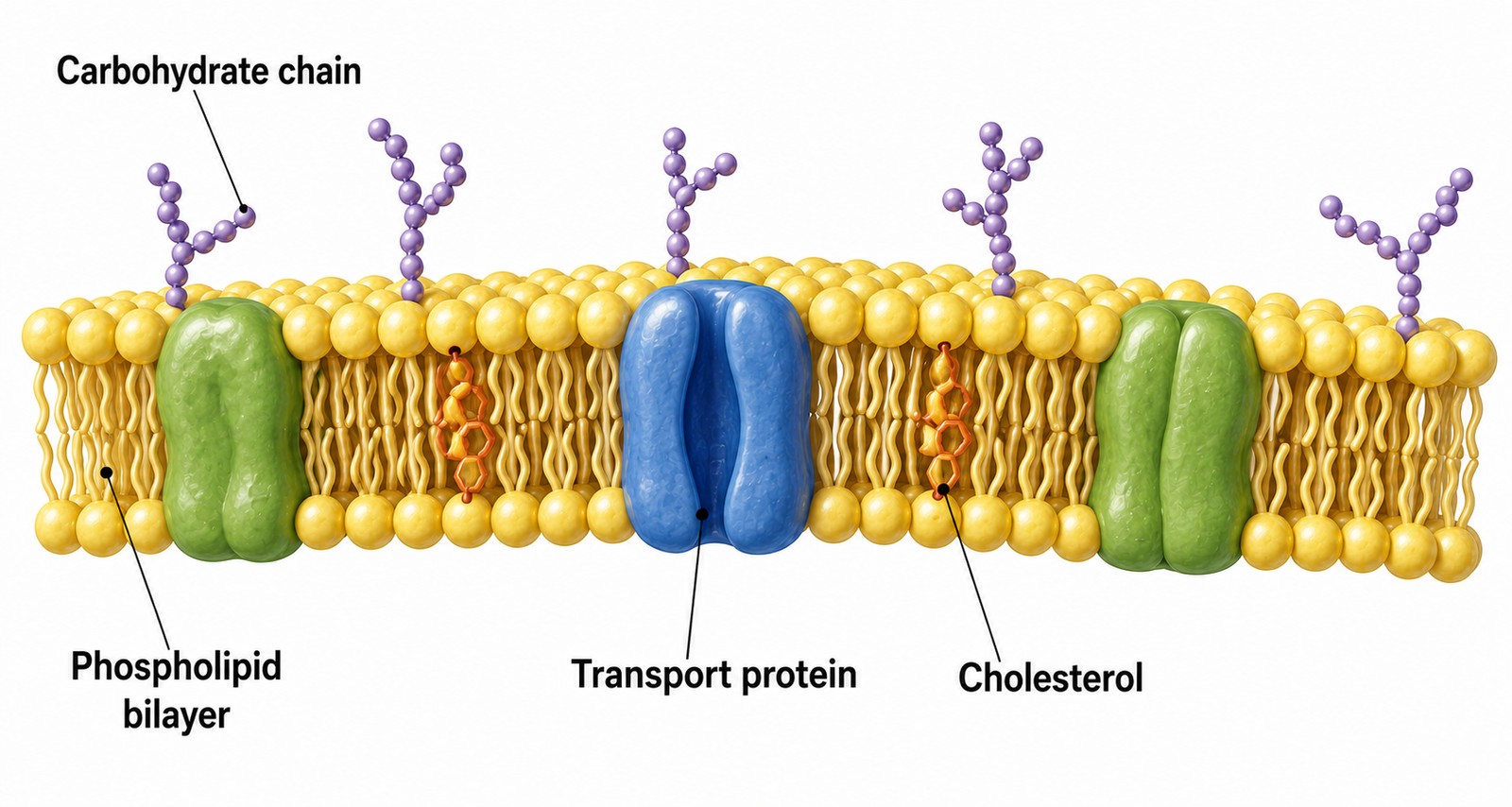
The phospholipid bilayer
Every cell membrane is built from two layers of phospholipids. Each phospholipid has:
A hydrophilic head (loves water) — faces outward toward the watery environment.
Two hydrophobic tails (avoid water) — face inward toward each other.
The result is a sandwich: heads outside, tails inside. This bilayer alone blocks anything large or charged. Small uncharged molecules (oxygen, carbon dioxide, water) slip through; ions and big molecules cannot.
Phospholipid bilayer with embedded proteins and cholesterol — the foundation of selective permeability.
Transport proteins fill the gaps
The bilayer alone can’t move ions, sugars, or amino acids. That’s where transport proteins come in. They span the bilayer and act as channels or pumps:
Channel proteins — open passages for specific molecules to flow through (passive).
Carrier proteins — bind a molecule on one side and release it on the other.
Pumps — use ATP to move molecules against their concentration gradient.
This combination — phospholipid bilayer + transport proteins — is what makes the membrane selectively permeable. That phrase shows up verbatim on the CBE.
Diffusion vs. osmosis vs. active transport
Diffusion: any molecule moving from high concentration to low. No ATP. Examples: O₂, CO₂.
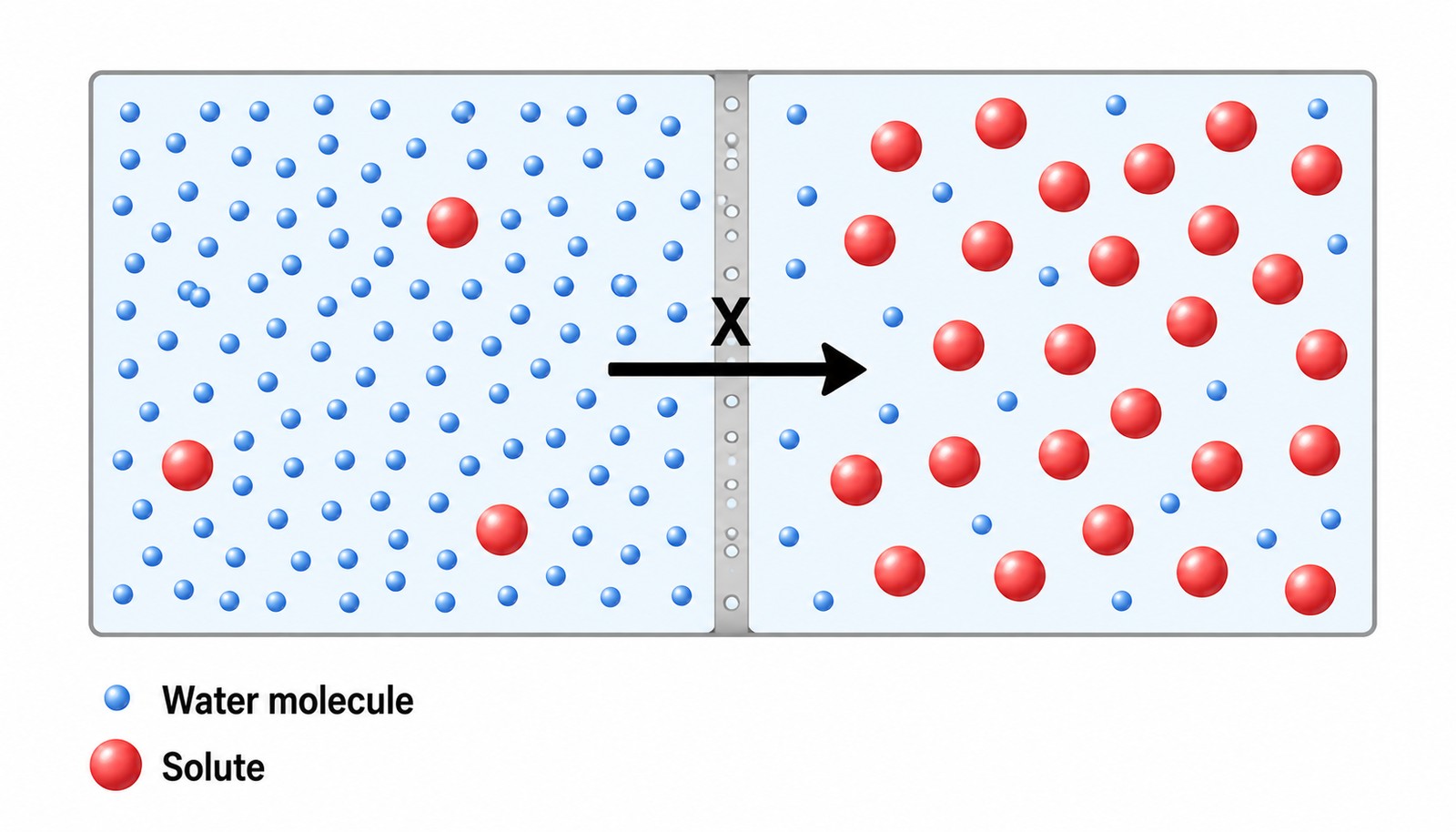
Osmosis: water moving across a semi-permeable membrane from low solute to high solute. No ATP.
Facilitated diffusion: passive transport through a channel or carrier protein. No ATP.
Active transport: pumping a molecule against its gradient (low → high). Requires ATP.
Water moves from low-solute side to high-solute side. That movement is osmosis — even though the diagram never says the word.
The three solution words you must memorize
Hypotonic — lower solute outside the cell. Water rushes in. Cell swells (and may burst).
Hypertonic — higher solute outside the cell. Water rushes out. Cell shrinks.
Isotonic — equal solute. No net water movement. Cell stays the same size.
Memory hack
Hypo = water flows into the cell (think “hippo dropping in”). Hyper = water flows out. Iso = no change.
Check yourself
Quick check #1
Which combination is responsible for the cell membrane's selective permeability?
The bilayer alone blocks ions and big molecules. Transport proteins create selective channels. Together they let the membrane choose what passes — that's selective permeability.
Quick check #2
An animal cell is placed in a hypertonic solution. What happens to the cell?
Hypertonic = MORE solute outside. Water moves from low-solute (inside) to high-solute (outside) by osmosis, so the cell loses water and shrinks. Animal cells have no wall to resist it.