Human Body Systems & Classification
Two topics in one lesson. Human body systems — respiratory and circulatory — are assessed on the current Biology CBE (TEKS 12A, 12B). Classification (the taxonomic hierarchy, the three domains of life) is no longer on the exam, since the 2020 Biology TEKS removed taxonomy, but the biology is real and worth knowing.


Two topics, one lesson
This lesson covers classification (how we organize living things) and human body systems (how organs work together). Both are compact topics, so they fit nicely in one lesson.
The taxonomic hierarchy
Linnaeus organized life into a nested hierarchy. Eight levels, from broadest to most specific:
- Domain (broadest)
- Kingdom
- Phylum
- Class
- Order
- Family
- Genus
- Species (most specific — individuals here are most similar)
Humans, for example: Eukarya / Animalia / Chordata / Mammalia / Primates / Hominidae / Homo / sapiens.
The deeper you go, the fewer organisms share that category — and the more similar they are. Two organisms in the same Species are nearly identical; two in the same Domain might share little beyond cell type.
The three domains of life
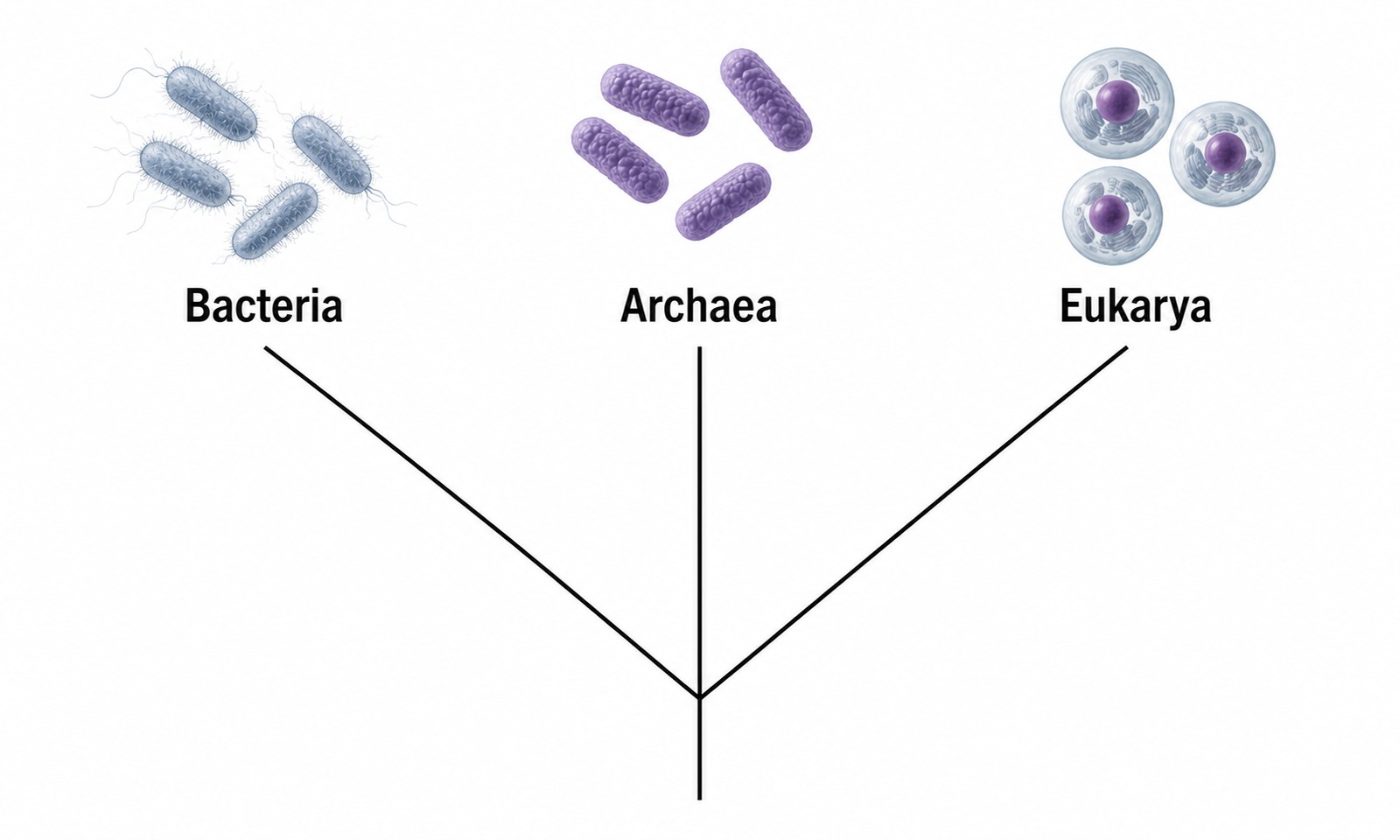
- Bacteria — prokaryotic (no nucleus, no membrane-bound organelles). Found everywhere.
- Archaea — prokaryotic, but biochemically distinct. Often live in extreme environments (hot springs, salt lakes, deep sea vents).
- Eukarya — eukaryotic (have a true nucleus and membrane-bound organelles). Includes animals, plants, fungi, and protists.
Karyotype: counting chromosomes
A karyotype is a photograph of all chromosomes from one cell, arranged in pairs by size. For humans, normal = 23 pairs (46 total).
- 22 autosome pairs (numbered 1-22).
- 1 sex chromosome pair: XX = female, XY = male.
Common conditions tested:
- Down syndrome — trisomy 21 (three copies of chromosome 21 instead of two).
- Turner syndrome — XO (one X chromosome only).
- Klinefelter syndrome — XXY (extra X in males).
Respiratory system
The respiratory system delivers oxygen to the blood and removes carbon dioxide. Air follows this path:
Nasal cavity → Trachea → Bronchi → Bronchioles → Alveoli
- Trachea — the main windpipe.
- Bronchi — two main branches, one to each lung.
- Bronchioles — smaller branches inside each lung.
- Alveoli — tiny air sacs at the end of bronchioles. This is where gas exchange happens.
- Diaphragm — muscle below the lungs that contracts to inhale.
Circulatory system basics
The heart has four chambers and pumps blood in two circuits:
- Right atrium → Right ventricle → lungs (pulmonary circuit).
- Left atrium → Left ventricle → body (systemic circuit).
Key fact: the left ventricle pumps oxygenated blood to the entire body — it’s the chamber with the thickest muscular wall.
Check yourself
Practice with CBE-style practice questions
- The three domains of life — which has no nucleus and lives in extreme environments?
- The taxonomic hierarchy — which level contains organisms most similar to each other?
- The respiratory system — which structure is the primary site of gas exchange?
- A karyotype — what condition is shown?
- Which heart chamber pumps oxygenated blood to the body?