Genetics & Punnett Squares: Predicting Inheritance with a 2×2 Grid
The Punnett square is the single most-tested tool on the Biology CBE. Master monohybrid crosses, dihybrid crosses, and the four key terms — homozygous, heterozygous, dominant, recessive.


The single most-asked tool
Roughly 20% of the Biology CBE involves a Punnett square. Once you know how to read and fill one in, an entire category of questions becomes automatic.
Four words you must know cold
Allele: one version of a gene. Written as a single letter — uppercase for dominant (A), lowercase for recessive (a).
Genotype: the actual allele combination. AA, Aa, or aa.
Phenotype: the visible trait expressed. AA and Aa show the dominant trait; aa shows the recessive trait.
Homozygous vs Heterozygous: same alleles (AA or aa) = homozygous. Different alleles (Aa) = heterozygous.
Monohybrid cross: Aa × Aa
A monohybrid cross tracks one trait with two alleles. The classic case: two heterozygous parents (Aa × Aa).
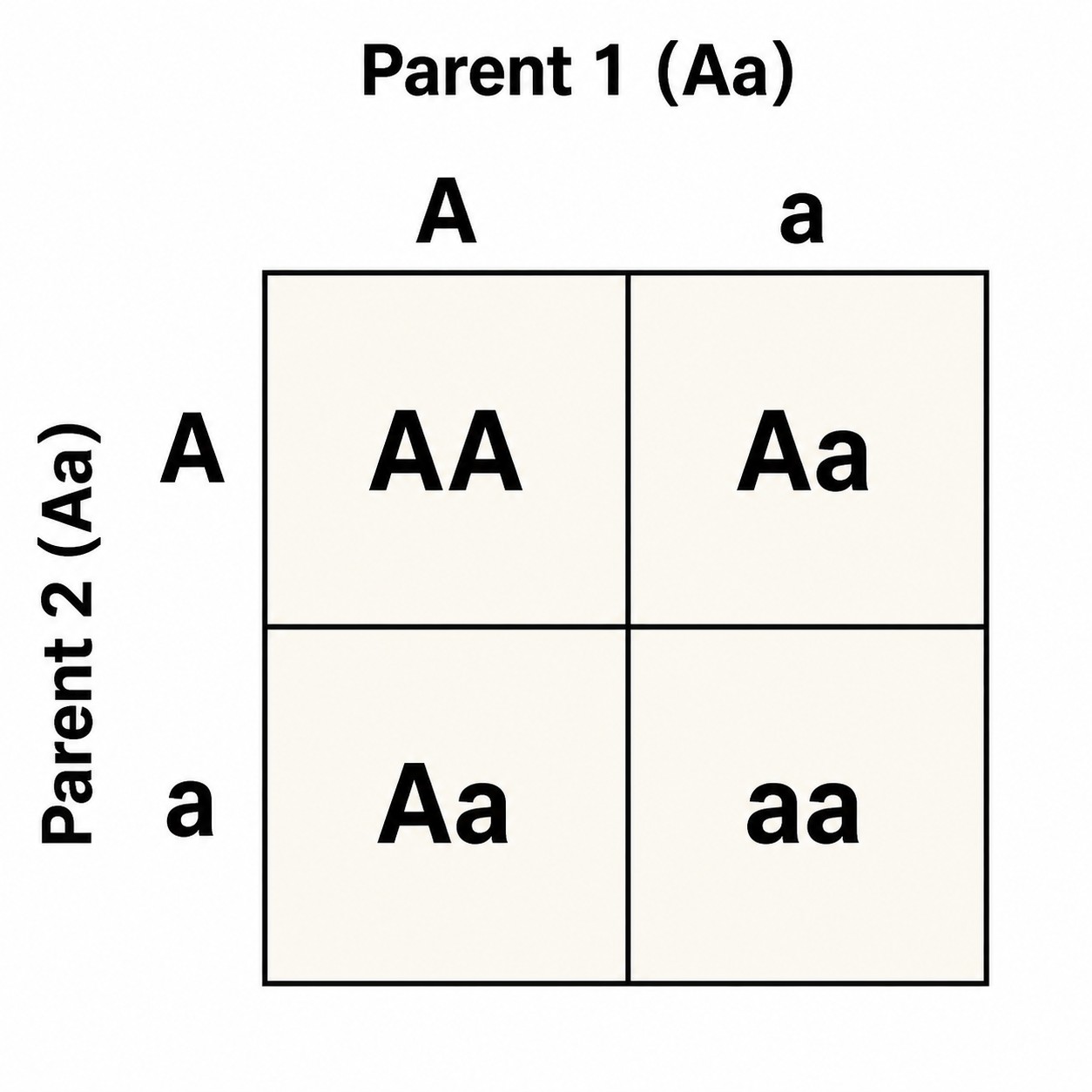
Aa × Aa results — memorize
- Genotype ratio: 1 AA : 2 Aa : 1 aa
- Phenotype ratio: 3 dominant : 1 recessive (because both AA and Aa show the dominant trait)
- Probability of homozygous recessive (aa): 1/4 = 25%
- Probability of heterozygous (Aa): 2/4 = 50%
Three other crosses worth memorizing
- AA × aa — all offspring Aa (100% heterozygous, 100% show dominant trait).
- Aa × aa — 50% Aa, 50% aa. Half show dominant, half show recessive.
- AA × Aa — 50% AA, 50% Aa. All show dominant.
Dihybrid cross: AaBb × AaBb
A dihybrid cross tracks two traits at once. Each parent produces 4 possible gametes (AB, Ab, aB, ab), giving you a 4×4 = 16-cell grid.
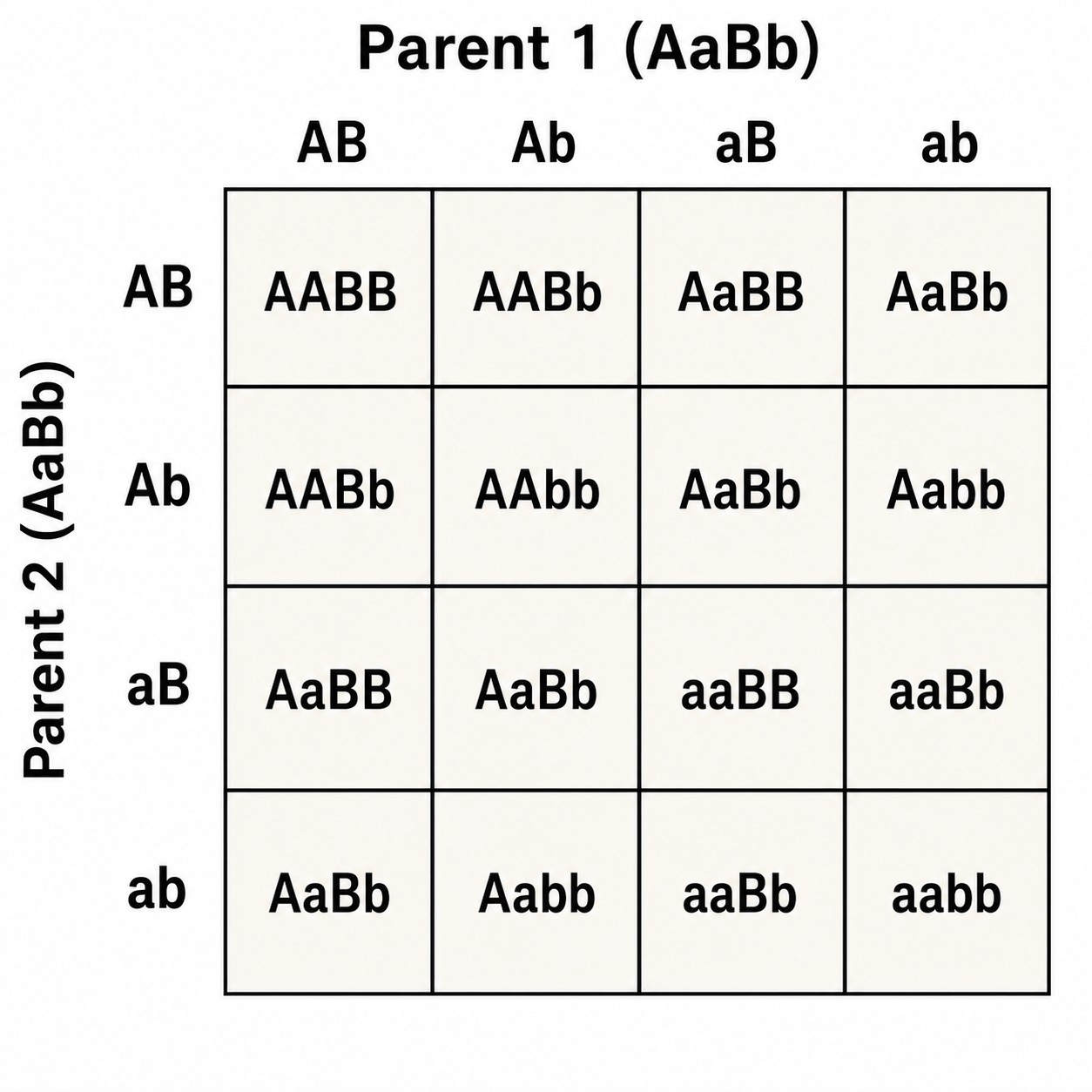
AaBb × AaBb phenotype ratio
9 : 3 : 3 : 1 — that’s 9/16 with both dominant, 3/16 with only one dominant, 3/16 with only the other dominant, and 1/16 with both recessive. Three-step strategy for any Punnett question
- Identify the cross type — how many traits? what are the parent genotypes? Write them out as letters.
- Draw the grid — 2×2 for monohybrid, 4×4 for dihybrid. List one parent’s alleles across the top, the other’s down the side.
- Fill each cell — combine the row letter with the column letter. Then count.
Exam tip
When a question asks for a probability, count the matching cells and divide by the total. aa probability in Aa × Aa? 1 cell out of 4 = 1/4 = 25%. Check yourself
Quick check #1
In a Punnett square for the cross Aa × Aa, what fraction of offspring are expected to be homozygous recessive (aa)?
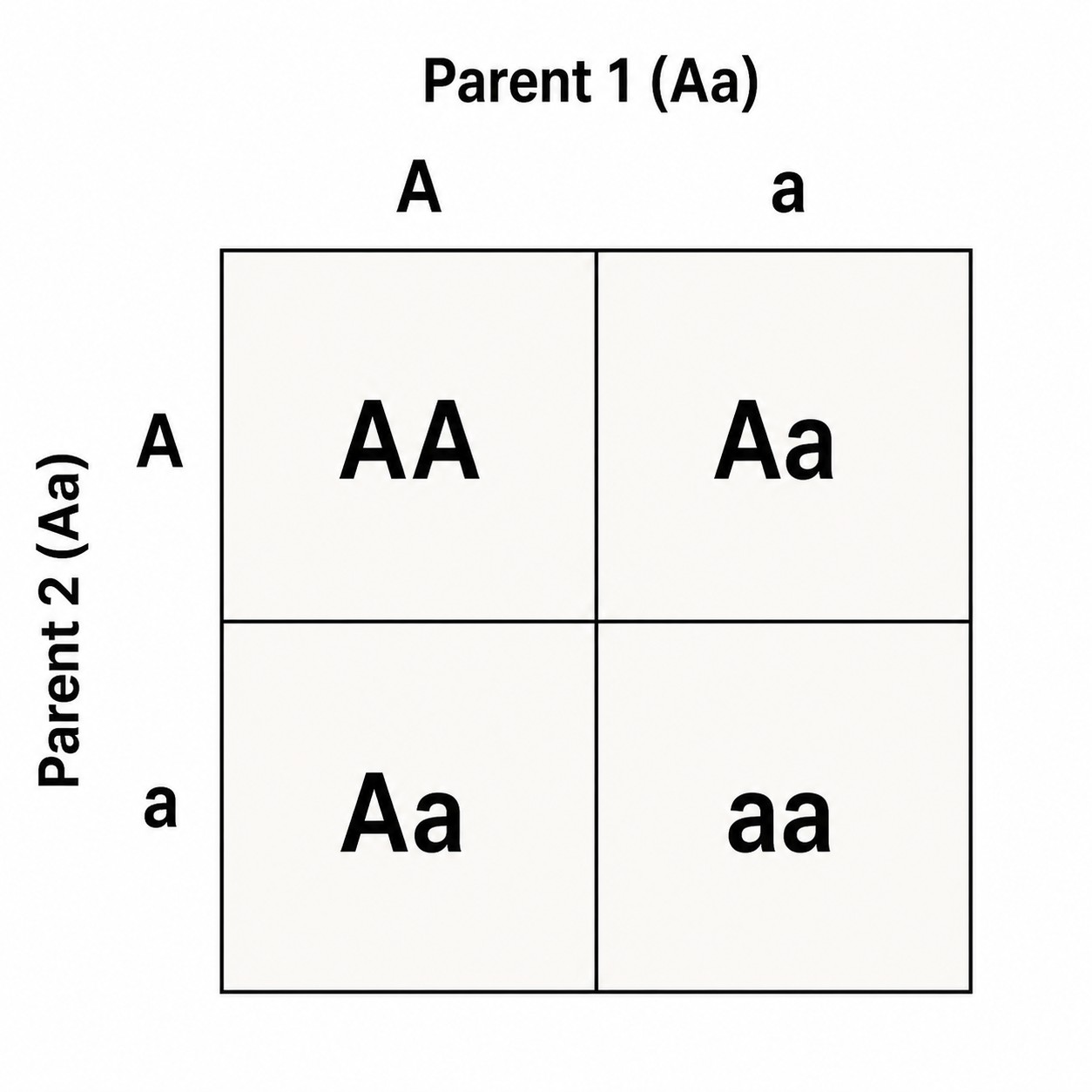
The Aa × Aa grid has cells AA, Aa, Aa, aa. Only one cell is aa — that's 1 out of 4, or 25%.
Quick check #2
For the cross AA × aa, what is the genotype of all offspring?
Every cell of this Punnett receives one A from the AA parent and one a from the aa parent — so all four cells are Aa. The offspring all show the dominant phenotype but carry the recessive allele.